
The devastating floods in Nepal have brought back memories of two major disasters in Uttarakhand in recent years, the Rishiganga tragedy of February 2021 and the Dharali disaster of August 2025, which caused extensive loss of life and property and left thousands struggling to rebuild their lives.

A recent study by scientists indicates that the Hindu Kush-Himalaya region is experiencing increased frequency and intensity of extreme weather events due to climate change, including rapid glacial melting and changing rainfall patterns. However, the research also cautions against solely blaming climate change, highlighting that human factors like population growth, commercial activities, and non-enforcement of regulations contribute significantly to the vulnerability and impact of these disasters. The study points out that many devastating floods originate from small glaciers and rain-fed streams, exacerbated by encroachment on unstable slopes and floodplains.

Veteran Congress leader Karan Singh has called for the establishment of a Himalayan authority involving all Himalayan nations, including India, Pakistan, and Nepal, to protect the fragile mountain range from destruction. He also criticised the four-laning of highways in Uttarakhand's Char Dham region, deeming it "reprehensible" due to its environmental impact. His appeal comes as Nepal grapples with devastating flash floods, highlighting the region's vulnerability.

A scientist from the Wadia Institute of Himalayan Geology highlights how climate change, including glacial retreat, shifting precipitation patterns, and rising nighttime temperatures, is exacerbating the risk of flash floods and landslides in the Himalayas, as seen in recent disasters in Nepal and Uttarakhand.

'There needs to be a monitoring of glaciers in high altitude areas and one needs to check regularly how geological changes are taking place.' 'We can mitigate that by regular monitoring but unfortunately, hardly any monitoring is happening.' 'And without monitoring those higher altitudes of Himalayas, people are suffering.'

'The trigger for the flood was definitely natural, but the damage that it caused was human-made.'

'This is no longer a single-hazard problem; it is a cascading, multi-hazard problem. A landslide never occurs in isolation. This entire chain is the cascading effect of what looks, at first, like a single disaster.'

'It appears to be a combination: A glacier breaking away, and a dam-like formation downstream reaching capacity and releasing water suddenly.'

Sikkim has identified 40 high-hazard glacial lakes, with 16 at the highest risk of catastrophic outbursts. Following a devastating GLOF in 2023, the state is developing India's first dedicated GLOF Risk Mitigation Protocol, using advanced monitoring and interdisciplinary approaches to protect downstream settlements and serve as a model for other Himalayan regions.

Over 130 Indian nationals, including Kailash Manasarovar Yatra pilgrims and tourists, are missing or stranded in Nepal following devastating flash floods that have cut off central districts and disrupted communication links. Indian states and the embassy in Kathmandu have launched helplines to assist those affected.

Following devastating flash floods in Nepal, experts are calling for systematic scientific assessments of glaciers to understand and mitigate hazards, alongside the development of a robust land use policy for the Himalayan region. The floods, which killed over 460 people and left thousands missing, are believed to be linked to climate change impacts on glaciers and permafrost.

'Raghav and I complement each other. He talks to me a lot about form and how he approaches his characters. Our paths are different, but we both are very much aligned emotionally.'

Japan is deepening its defence relationship with India while simultaneously expanding its economic, infrastructure and security engagement with countries around India -- particularly Bangladesh. The result is an emerging Japanese conception of South Asia in which India remains the strategic anchor, but the geography surrounding India is becoming increasingly important, points out Varun Arya.

'All this diversity that our country provides brings in a lot of learnings.' 'That is what I really end up sharing with the whole community.' 'But it all comes through making my shoes dirty.'
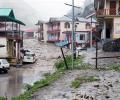
'The government only wakes up after devastation.' 'The government does not understand the gravity of the situation nor they do not want to understand the gravity of the situation.'
Discover the only way to travel, where fun meets fitness!

Tensions between Shankaracharya Swami Avimukteshwaranand Saraswati and the Uttar Pradesh government led by Chief Minister Yogi Adityanath have drawn national attention in recent months.

Activists from Himalayan states condemn the arrest of Sonam Wangchuk, demanding his release and supporting the call for statehood and inclusion in the Sixth Schedule of the Constitution. They also warn of a larger crisis unfolding across the Himalayan region due to climate change and poor governance.
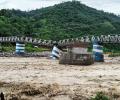
Historically, October has seen some of the worst landslide events in Darjeeling and Sikkim Himalayas.
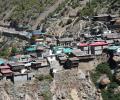
On August 5, 1953, Jawaharlal Nehru sent a strange note to the foreign secretary. It is worth mentioning because it was symptomatic of the lack of knowledge about Western Tibet in India and in South Block in particular, notes Claude Arpi.
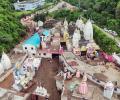
'What we are witnessing is not a freak incidence or a freak occurrence, but a new climate reality where warming oceans, monsoon variability and local geography are combining to produce extreme events.'
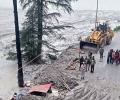
Experts question whether a cloudburst caused the recent flash flood in Uttarkashi, India, citing insufficient rainfall and other potential factors like ice chunks, rockfalls, or landslides.
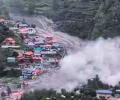
A cloudburst in the high altitude villages of Dharali in Uttarkashi district of Uttarakhand led to flash floods, causing damage to houses and sweeping away structures. Several people are feared buried under debris.
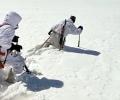
Indo-Tibetan Border Police personnel patrol a snow-bound area at 15,000 feet in sub-zero temperatures in the Uttarakhand Himalayas, February 17, 2022.

'The Himalayas are the Creator of Life.'
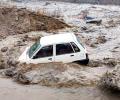
The India Meteorological Department (IMD) forecasts above-normal rainfall for India in September, following a monsoon season marked by heavy downpours and related disasters in various regions. The forecast indicates normal to above-normal rainfall for most areas, with some exceptions in the northeast, east, extreme south peninsular India, and parts of northwest India.

Add adventure to your winterr vacay with any of these easy, one-day Himalayan treks that you can attempt by yourself.
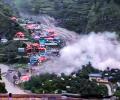
'There is a clear relationship between the Char Dham road widening and these landslides.' 'The situation has further worsened with the massive influx of tourists whose number are running into several lakhs per month.' 'No parameters have been laid down to control tourist inflow and the result is that the Char Dham yatra has seen a sharp escalation in accidents and loss of lives.'

'Half of China, India, Pakistan, Bangladesh Nepal, Bhutan, Myanmar, which are among the most populous countries in the world, are dependent on the rivers and glaciers of the Himalayas for sustenance.'

'Mountaineering is never 'easy'. Nothing is in your hands, you have to be prepared. That's the same for life as well.'

'It is daunting, for sure, because you're rowing upstream.'

'Above 2,000 metres the gradient of the Himalayas is very steep and if you build any infrastructure (roads, dams, hydro power projects) in these regions, it will not be able to sustain these events (the onslaught of debris that comes down with great speeds).'

GetAhead reader Kartikeya Virmani shares his visit to the Kedarnath temple in Uttarakhand in the Garhwal Himalayas.

'These kinds of tunnels are not meant for the Himalayas.' 'Development should be good for all people and not where you make a tunnel and 40 people get trapped.'
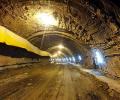
'My belief that I could protect the Himalayas was shattered.'

The study conducted a systematic survey of landslides and derived a statistical model, aimed at quantifying landslide susceptibility along the NH-7 at a high spatial resolution, the findings said.
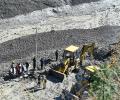
'We have been appealing to various governments for so many years that there should be no dams in the Himalayas, but no one listens.' 'Nature responded in its own way.'

More than 150 labourers working in a power project are missing, officials said.
Even as the Uttarakhand floods are being referred to as man-made disasters, experts say such disasters are waiting to happen at places like Ooty and Munnar.

Bill Aitken came to India nearly 60 years ago. He never returned. An Indian citizen since 1972, he tells Rediff.com's Archana Masih how India changed his life forever.
